Ship’s Log Week Forty One
Australia here we come, with a whoosh and a rock and roll.
One thousand, one hundred and fifteen nautical miles to go, an eight day sail ahead for Walrus as she set out on Leg 8 from Vanuatu to Mackay in Queensland. A passage taking her from the Pacific Ocean through the Great Barrier Reef to the Coral Sea, along the north-eastern coastline of Australia.
During the first few days we had light winds. Walrus sailed with asymmetric, a pale grey, paper thin sail with separate furling line running from bow to stern along the deck, raised by halyard and flown on one side of the forestay or the other, depending on wind direction. A wonderful sail for harnessing light winds in a beam or broad reach sail position. Winds can prove fickle, defying forecasts.
One and a half days into the sail the wind dropped and changed direction before Walrus crew had time to gybe or lower the sail, the result our asymmetric sail wrapped around and under the anchor and tore. If this adventure has taught us anything it’s that boats, with all the equipment that’s needed to propel them through the oceans, are vulnerable to breakages. We lowered the asymmetric, stowed it below decks in what had become ‘Gerald’s forard cabin’ to await a sail loft and repair.
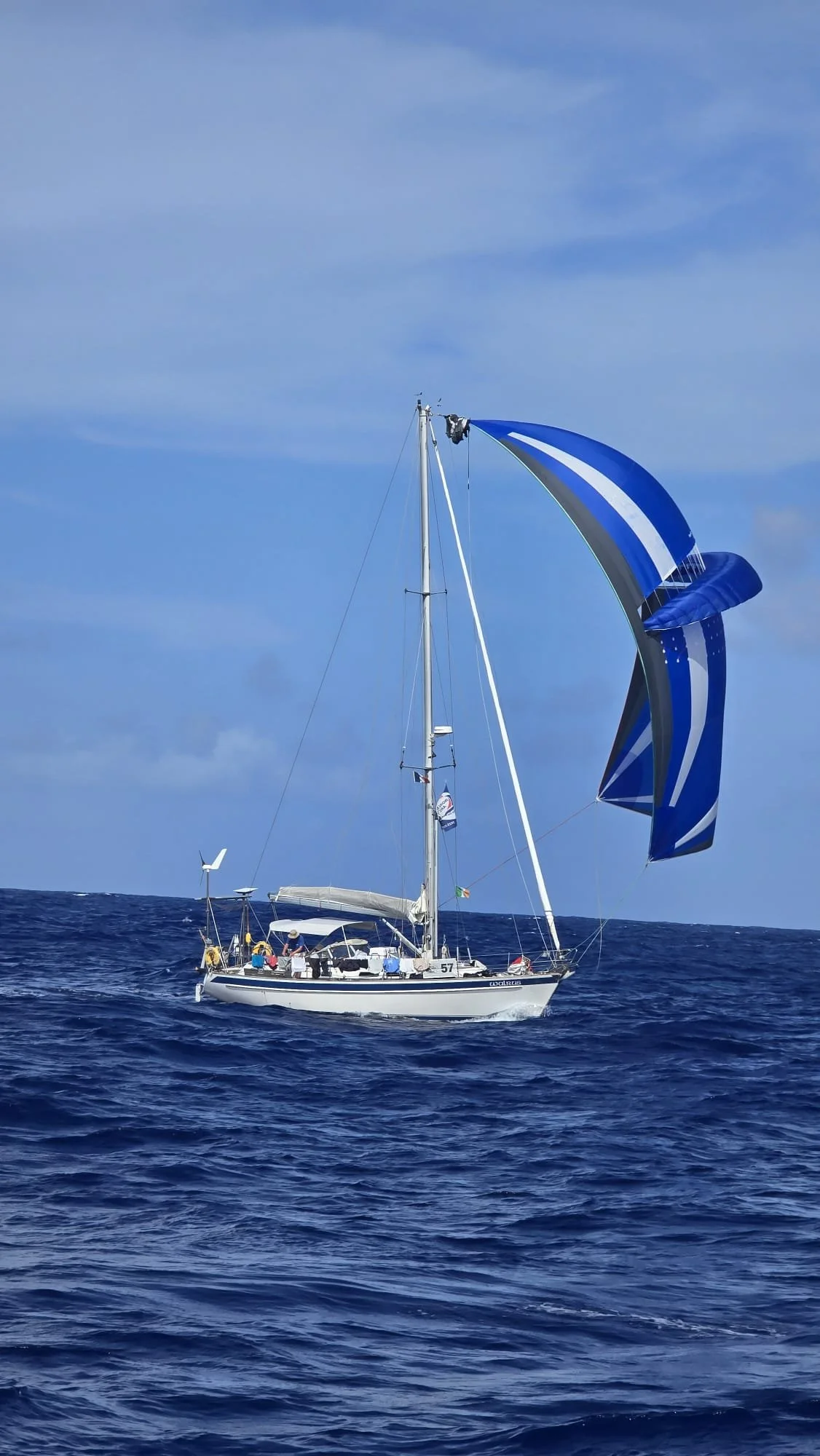
Reluctantly we motored. Motoring causes a frisson of anxious wind-watching. ‘We’re sailors, we need to sail’, I hear one crew member after another mutter. Not long to wait, still with light winds, in place of the asymmetric, we raised the parasailor. For a day or two Walrus beautiful bright blue, beast of a down-wind sail kept us moving, until the wind picked up and we returned to her go-to sail plan of main and foresail, a less exciting but altogether easier to handle option.
There followed two or three days of glorious plain sailing, surprisingly rare. All was harmony, blue sea with white crested waves, the wind in Walrus sails and a course set for our destination, Mackay.
On watch, for a moment the view ahead conjured up a 1960s movie set with yacht, (probably located in a film studio somewhere west of London) moving mechanically in imaginary waves, while an ocean scene played in the background. In the foreground, bouffant haired girls wearing ample, possibly knitted, bikinis (no cheeky-cut, lycra G strings in those days) relaxing on deck with a Babysham or dry martini in hand, and barely a hair out of place. Cue Cliff, and we’re all going on a Summer Holiday… With no more worries for a week or two.
Oops… nearly got carried away. An overly enthusiastic wave slapping against Walrus’ hull followed by Ted’s arrival to take over the watch woke me from my reverie, back to reality and down to the galley. Skipper and crew had a circumnavigation to complete.
Food on the go
Below decks, cooking the evening meal had become something of a sport with the need for deft movement, steadfast positioning of limbs and the luck of the Gods in avoiding contact with the hot oven door as it pivoted to and fro on the gimbals that kept liquid in saucepans, countering Walrus’ side to side, rocky roly movement.
Walrus’ cooker is powered by gas; the mechanism for lighting the cooker’s two top burners and the oven relying on the co-ordination of depression of a knob on the cooker fascia with one hand and poking the end of the lighter while pressing the button that triggers the clicking ignition of a spark with the other.
Once lit the button on the fascia is released and cooking can commence. A task that sounds simple to execute, is simple on land, a little trickier at sea but definitely do-able in the ordinary course of events. At first, I thought I’d lost the knack, and bent down closer to the swinging oven door, to get a better look.
No joy..there was definitely a problem. With a week to go before we reached land and limited provisions that could be served cold or raw, the oven refused to light. After much experimentation, the best remedy that I could come up with involved careful wedging of the cooking tongs between the knob on the fascia and the handle for opening and shutting the oven door. Low enough to dodge the rail for drying tea towels, as the cooker pivoted backwards and forwards but high enough to keep the tongs sufficiently open to maintain a permanent flow of gas.
A risky and slightly dangerous solution, maybe, but it worked. Now imagine transferring a roasting tin of potatoes into the hot oven while manipulating oven knob, lighter and positioning the tongs simultaneously… and, not forgetting maintaining the Helly-Hansen-wearing Sumo-wrestler legs wide-apart stance needed to keep balance and avoid being burnt by the swinging oven door.
Cooking at home in Maltshovel House will seem a breeze, maybe boring, after this. Even Jamie Oliver, the wonder-boy of cheffing and creator of easy-living-family-life, might have resorted to foul language, in the circumstances, I said to myself on more than one occasion. In between wrestling with Walrus’ maintenance challenges there were moments which brought the crew together in celebration.
Three days into the passage and Gerald’s fishing activity proved successful. The line twitched and a second wahoo was landed on Walrus deck, providing us with the most delicious of fresh supplies for the next three evenings. Reason enough to raise a glass to Neptune once the sun was over the yard-arm (note to self - must look up the origin of this saying, I’ve no doubt there’s an illustrious history and a story to tell). I make no excuse for dedicating the opening paragraphs to ‘talk from the galley’ - food plays an important part in the well-being of all onboard.
Gerald and Ted both took my plight to heart - after probing the depths of the cooker’s charred innards, they came to the same conclusion, a replacement part was needed. Starlink was duly switched on and the cooker part identified from a myriad of similar-looking items.
Amongst Dicky’s many tasks was communication ahead to co-ordinate Walrus’ maintenance in the next viable port of call, liaise with specialists and order parts. Nailing the purchase and delivery of Walrus’ spares had been hit and miss, with some companies proving super efficient and helpful and others falling short, causing complicated and protracted exchanges.
Too often precious items ordered weeks in advance failed to turn up at the allotted destination on time, were not the correct parts, or were kept in a holding pattern of bureaucracy all the more challenging to resolve while at sea. Collectively we kept fingers crossed for the safe delivery of the missing oven component. I crossed my toes too.
The final stretch: A whale of a time.
One hundred and eighty-five million years ago, the southern hemisphere, known as Goodwana split away from a global landmass. Sixty-five million years ago Australia was formed when the earth’s internal thermal dynamics set the process of continental drift and tectonic plate movement in motion causing Australia to separate from Antarctica and the remains of Goodwana. In doing so creating a continent with unique flora and fauna unknown to Europeans until 1770 when Capt. James Cook’s South Pacific voyage of discovery on Endeavour, with naturalist, Sir Joseph Banks onboard landed on the East coast of Australia.
The process of continental drift has continued and, to this day, Australia’s movement has been measured and recorded at five centimetres a year in a north-easterly trajectory into the Pacific Ocean. There have been moments when the wind died for days on end, Walrus engine failed, time dragged and the thought crossed my mind that perhaps it might be quicker and less hassle to wait for Australia to meet Walrus.
As if the swell, winds and currents were not enough to contend with Australia had more to challenge the intrepid sailors of yester year and today. It is a testament to the persistence, determination and resilience of explorers in times gone by that the continent of Australia became charted and navigable for future generations.
It was Charles Darwin aboard HMS Beagle (1800) who first reported encountering the limestone, calcified skeletons forming reefs spanning two thousand miles of the eastern coast of Australia and identified this as a ‘barrier reef’. From the area east of Mackay northwards the reefs form an almost unbroken ridge, which our onboard guide to this area described as, ‘a nearly impenetrable maze perforated by intricate channels’, (100 Magic Miles, Colfelt, D. 2022).
Two hundred and forty-four years later here we are on Walrus with all the benefits that modern technology’s GPS and AIS images provide, planning an early morning course via Bramble Passage, a narrow charted channel which branches off the main commercial route, Hydrographer’s passage, through the Barrier Reef. Walrus’ destination a short sail across the Coral Sea to immigration, bio-security (no, we haven’t seen any insects on board - at least not since I crushed the last weevil) and customs (no contraband, honest) co-ordinated by the World ARC yellow shirt team in Mackay, Queensland.
Let’s not jump the gun, we had the barrier reef to cross before our arrival in Australia was assured. Navigation is Dicky’s forte and executing tricky passages in the dark his piece de resistance. Nevertheless, I think I speak for everyone onboard when I tell you we had moments of unease as Walrus made her way through Bramble Passage with few metres to spare on either side, before being spat out the other end. The tension mounted as Walrus arrived in the Coral Sea in a whoosh with a wild, rocking, rolling, twisting and lurching movement, which below decks felt very much like being in a washing machine when the on switch has just been pressed.
Gerald, Ted and Dicky let out a sigh of relief on deck as Walrus gradually righted herself and we started the sail across the Coral Sea. Below decks I put the kettle on… a cup of tea was needed to steady the nerves.
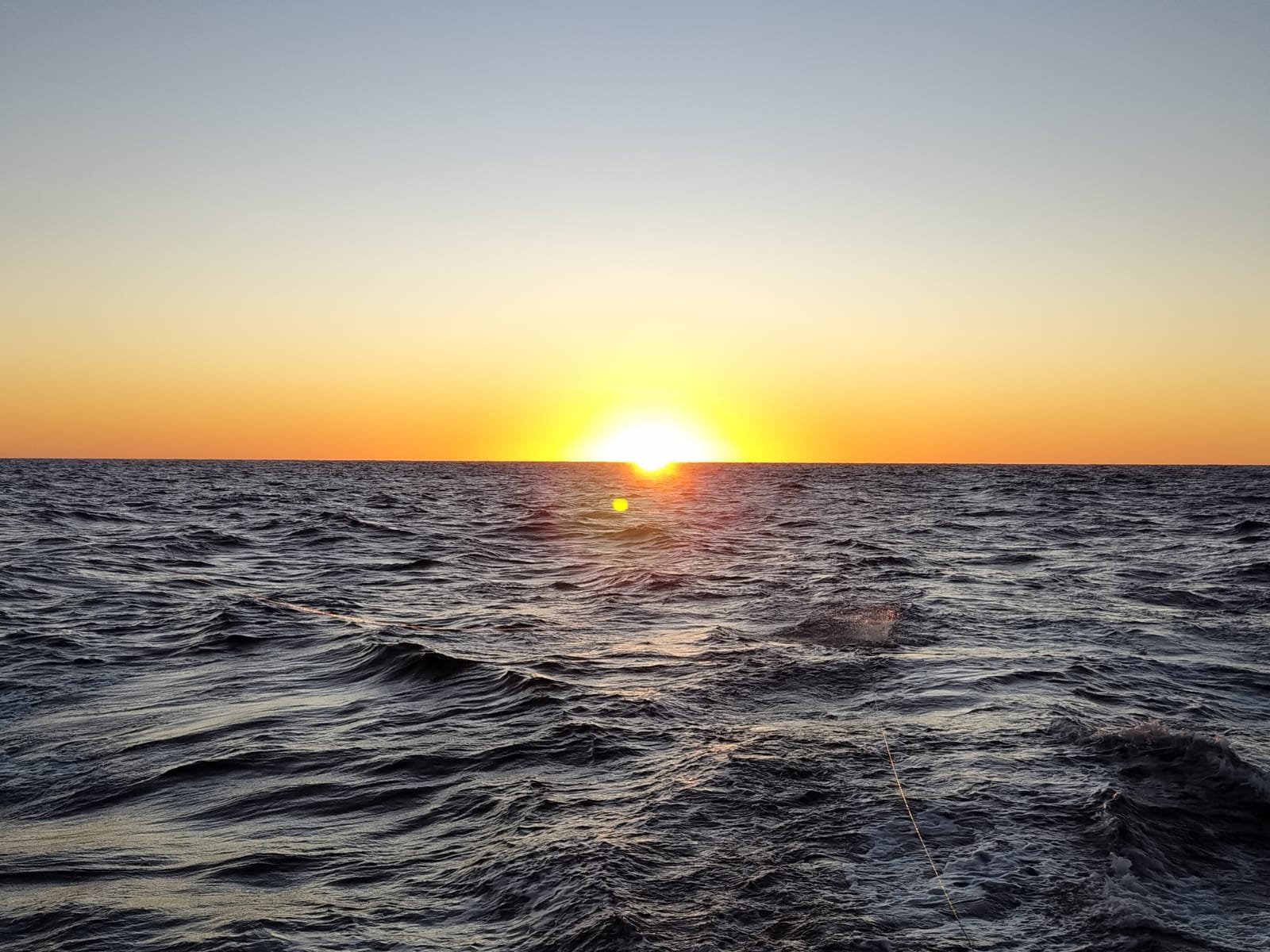
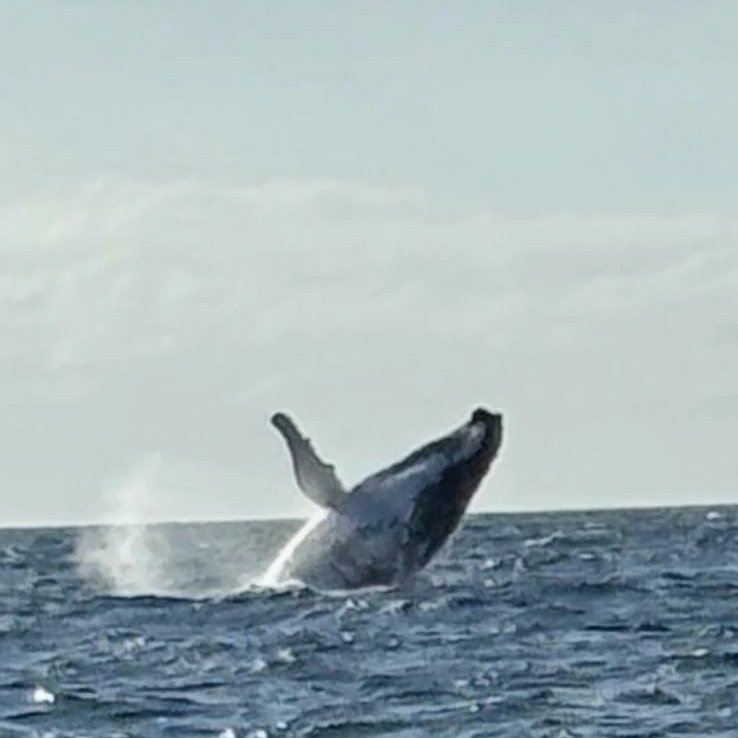
Fingers of early morning sunlight spread across a pale blue sky as dawn lit the horizon and we began to take in our surroundings. This journey has provided us with extraordinary memories enough to fill a lifetime. There was more to come. Ted’s pronouncement that it was far too shallow for the much anticipated sighting of a humpback whale, was followed moments later, by, yes, you guessed it… cries of… ‘there it is…’ as a Humpback whale breached out of the sea, high in the air, just 50 metres away from Walrus. A heart-stopping moment, as we witnessed one of nature’s giants greet us in style with a breath-taking show of Humpback agility and bravado. A fitting end to our five month journey across the Pacific Ocean.
The journey so far… and getting ready to go again
Walrus set out from Gibraltar on 26th November 2024 and arrived in Mackay eight months later having sailed 12,650 miles across two of the world’s five oceans. This felt a major achievement and a moment to pause and reflect on the miles covered so far, an emotional and physical feat for all on board and a voyage that had seen Walrus’ sails used like never before, with every one of her systems stretched to achieve her best performance day in day out.
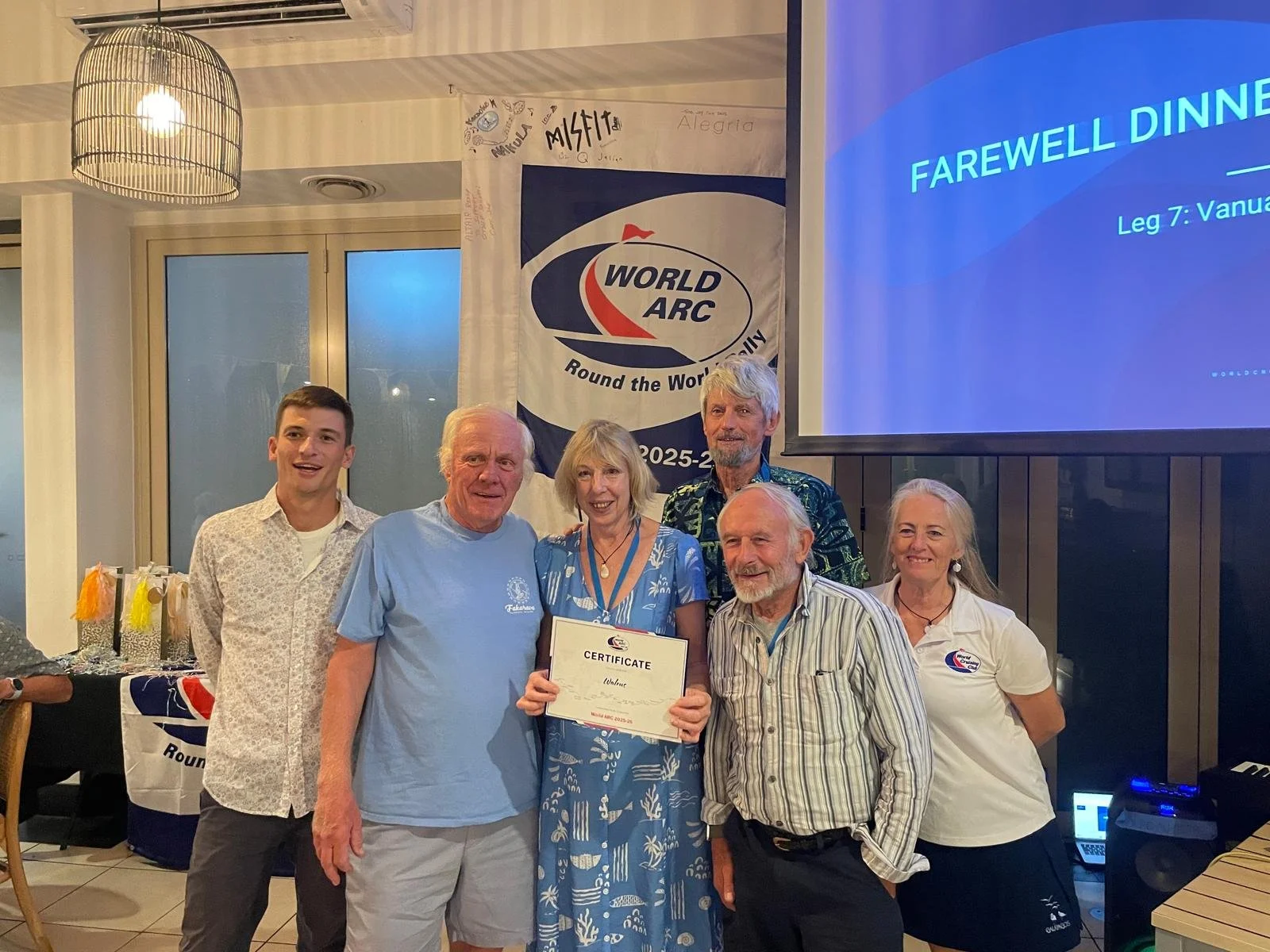
Prize-giving in Mackay was a suitably celebratory event with, what had come to feel like our World ARC family, squeezed into the somewhat small function room at the Mantra Hotel, Mackay Marina for speeches, farewells, homegrown music and a buffet supper. We said a heartfelt thank you and sad farewell to World ARC yellow shirt team member, Paul. Paul and Lesley had supported the WARC fleet from the get-go in St Lucia, when thirty-three yachts set off, unknowing and green but keen and eager, across oceans and continents to their arrival in Mackay, a somewhat wiser and more seasoned fleet of sailors.
The WARC yellow shirt team’s role had been significant if at times, unsung. Lesley, Paul and for a short time, Rachel’s not insignificant task list included navigating and smoothing the complexities of immigration and bio-security checks, addressing challenges faced by the fleet with the safety of all a priority and, not to forget the team’s travel through the maze of airlines and airports from remote destination to destination, always keeping one step ahead of the fleet. For Yellow Shirt, Paul, it was time to move on to pastures or oceans new to pursue a career as a yacht surveyor.
For Walrus it was time for some TLC and to have her maintenance attended to. She was duly scheduled for lifting onto the hard standing of the shipyard to review and fix any damage that might have occurred as a result of her misadventures with the coral bommie in Malolo Cove.
For once there was good news, minor scratches, easily resolved during the course of a day’s hard work by the shipyard team.
If we thought this was a time to rest on our laurels, the realisation Walrus had a further 1450 miles to sail around the northern most point of Australia to Darwin in the northern territories before setting off on the second half of the World ARC Rally 2025-26, was a good reminder of the need to crack on, as ever. If you’re wondering, keeping fingers crossed worked and Walrus new cooker part arrived, just in time (more of this later) unlike Dickie’s driving licence which failed to turn up three or four weeks after being despatched with care from the UK.
There’s always another sea to see.
During the course of the next six weeks we sailed Walrus from the Coral Sea, through the Whitsunday Islands, also known as the Cumberlands, past the most northerly point of Australia, Cape York, through the Torres Strait to Carpenteria Bay, and the Arafura Sea with its high waves and rough swell; on to the Timor Sea, through the Dundas Strait to Darwin’s Fannie Bay. From there once Walrus had passed another rigorous bio-security check and had outlets flushed with disinfectant, we settled in Tipperary Waters Marina for a break before the start of the World ARC circumnavigation second half.
Walrus Down Under, a few highlights
Wallabies on the beach… Cape Hillsborough National Park on the beach at dawn watching wild wallabies lollop across the beach with two rescued kangaroos joining them in a breakfast feast by the water’s edge. It was surprisingly chilly, we were bundled up with fleeces and scarves, for the first time since leaving England.
The wallabies ate food washed up by the sea to supplement their diet, and a local park ranger added pony nuts to the mix when supplies were short. We climbed over rocks, up a steep slope with our guide to look down on the beach, stopping to taste live, citrusy fresh, green ants en route. An exquisite, never to be forgotten culinary experience, followed by breakfast served at trestle tables in a picnic area near the beach. Women were advised to flush the loos before taking a pee, to avoid the unwanted appearance of a large toad at just the wrong moment.
A whale a day
We sighted whales as we sailed north from Mackay every day over a period of eight consecutive days. Sometimes just the dorsal fins, sometimes a lone humpback whale and sometimes several in a group. One morning, as Walrus was sailing towards the Whitsunday Islands, directly ahead, on Walrus bow, two enormous whale tails, side by side, flip flapped alternately on the water’s surface. It seemed the whales were engaged in communication so absorbing that Walrus’ encroaching presence had gone unnoticed. We changed course to avoid disturbing the whale’s conversation, which continued with repeated whale tail water slapping for well over ten minutes. A magic moment.
Hamilton Island in the Whitsundays
Walrus was moored in Hamilton Island’s marina alongside super smart yachts and a diving boat or two. As we left the marina pontoon, we were pulled up short by the bizarre sight of a stream of golf buggies cruising the waterfront. Switching to Number-Six-mode (think sixties cult TV series, The Prisoner) we adopted a fleet of foot approach to dodging the none-too-expert attempts to manage golf buggy manoeuvres and avoid being mown down.
Gerald endeavored to endear himself to the local wildlife and was greeted by a ferocious wide-beaked hissing sound as he made polite advances to a curlew walking regally along the pavement. As for Ted, he narrowly avoided a possum running up his trouser leg. We stopped to take photos of a little wallaby nibbling at the grass as we passed by on our way to a wonderful Asian fusion restaurant overlooking white sands and a crystal blue sea. Top marks for the spicy margarita, the best of the circumnavigation, so far.
Next day we climbed to the high point of the island, from there we had a 360 view of wooded mountainous islands surrounded by white sands, craggy shorelines and lapped by the waters of the Coral Sea. The colours and contours, from this height, revealed the similarities to the Lake District that had led Captain James Cook to name the islands The Cumberlands.
If you’ve visited the Lake District you’re likely to have experienced the sort of weather that calls for a long afternoon cream tea and possibly an early evening pre-dinner drink rolled into one. Rainfall, mackintoshes and wellington boots are the order of the day - that’s where the Whitsunday Islands differ; here sun hats, bikinis and iced cocktails by the pool are de rigeur.
Magnetic Island… on the hunt for a wild koala
We left Walrus in the marina and spent a day exploring Magnetic Island, one of the few places in eastern Australia where koala bears continue to live in the wild. I was optimistic about our koala bear tracking abilities as we set off walking along the coast, past Norfolk pines growing from rocky outcrops above the deep blue sea.
After a mile or so, we realised Magnetic Island was larger than the illustrated tourist map had led us to believe. We headed to the nearest bus stop, where fortuitously, one of a very few buses stopped minutes later. Our ‘on land’ navigational skills were somewhat rusty and, having taken a detour to a bay on the other side of the island, we alighted at the side of a well marked track leading uphill.
Caught between looking down to find an even path through the rusty red rocks littering the track and keeping an eye out for the, as yet, elusive wild koala bear in the tree tops we trekked onwards and upwards. It was not long before we passed hikers on their way back down the trail, and there was talk of a koala sighting up ahead. With eager anticipation, on my part at least, we headed onwards, rounded a corner and there he was sitting in the crook of a branch two thirds of the way up a eucalyptus tree, just as cute and furry-looking as the toy I’d had as a child.
A small gathering of koala bear fans stood beneath, watching his every move, which, as I learned from one of the experts, are few and far between. Koala bears, being creatures with a diet limited to the leaves of one species of eucalyptus tree have a life of little movement and much sleep (twenty-two hours in every twenty-four). We waited patiently for a sign of life. Dickie gave up and went on in search of the signposted remains of a Second World War gun outpost.
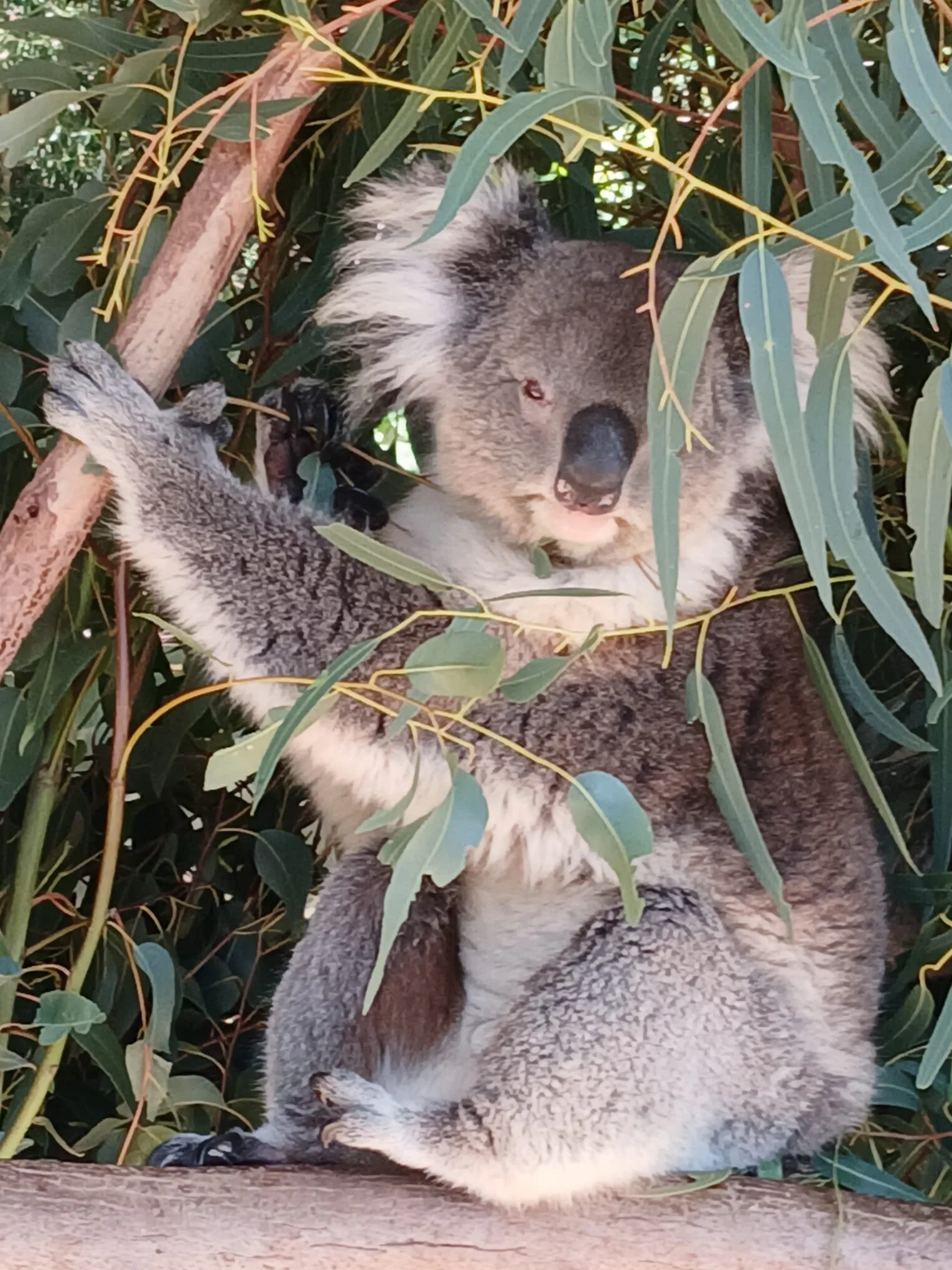
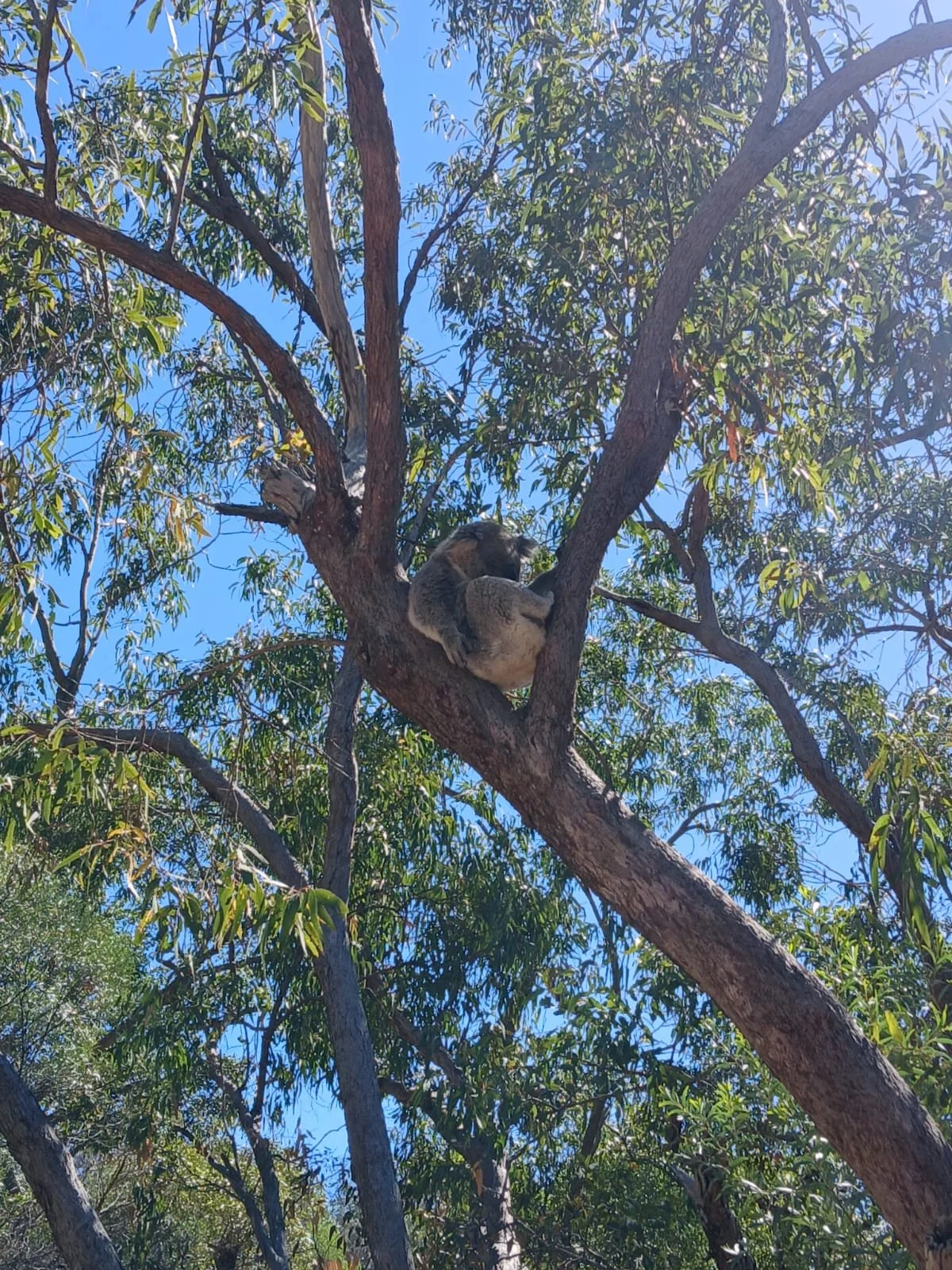
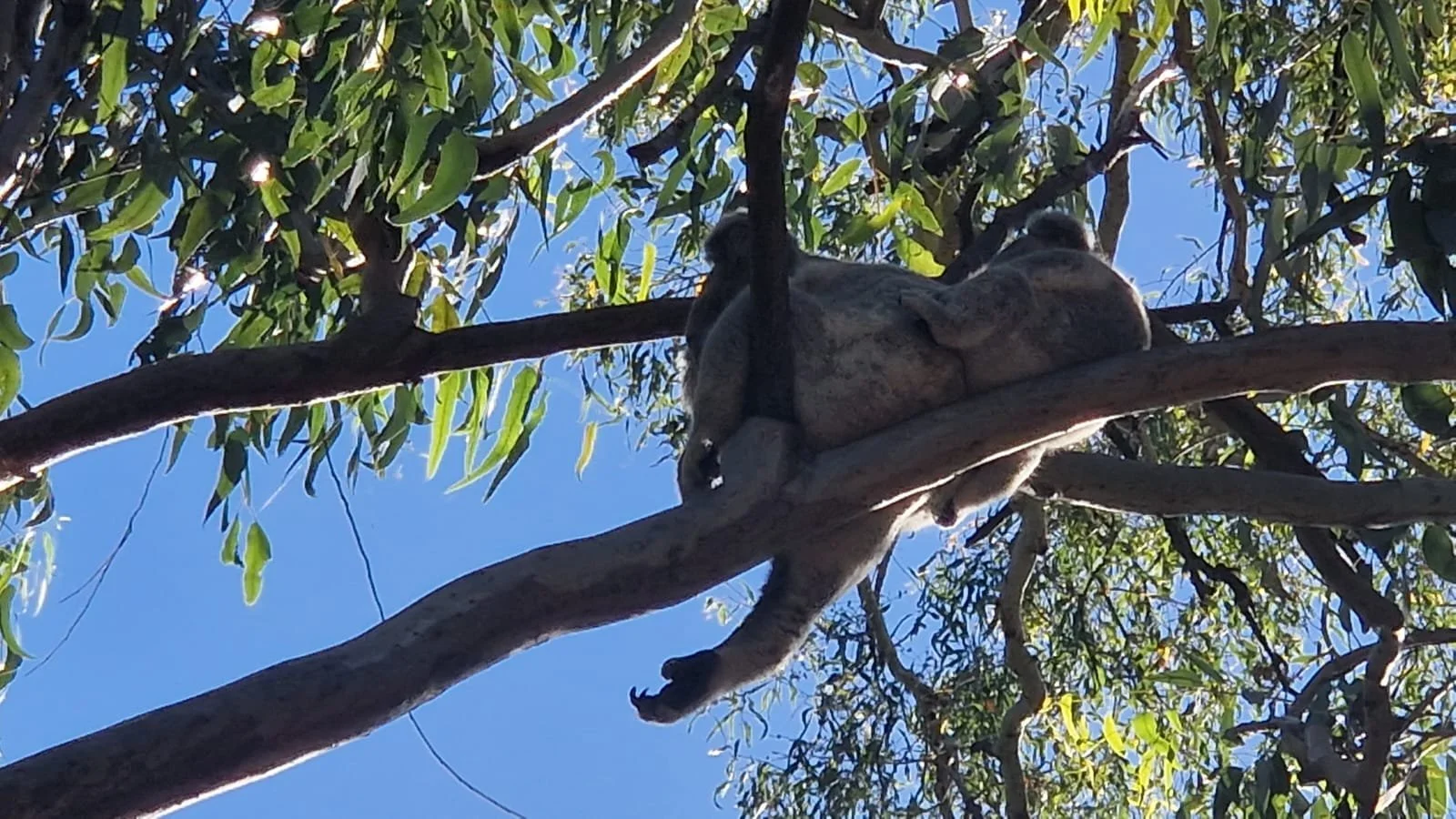
Some minutes later the koala bear wriggled his furry ears, yawned, stretched a long furry arm to scratch under his armpit, re-settled his posterior on the branch and went back to sleep, much like the dormouse at the tea party in Alice in Wonderland. I felt privileged to have seen a koala bear, in his natural environment doing the thing he did best… snoozing.
Cairns: Karunda Railway, the fixing of the cooker and ferris wheel buddies.
Walrus was moored in the marina, a walk down a banyan tree avenue, lit with fairy lights at night, away from the city centre. Cairns proved to be a bright, friendly, vibrant city with bustling local market for provisions, a cafe culture and no end of settlers from Europe keen to tell their story and sing the praises of a newly found home country. A young guy serving wake-you-up-in-the-morning coffee had arrived nine months ago from the coast of Lincolnshire on a young person’s work visa… he swore he was never going back. An older couple emigrated sixty years ago, they were on vacation in Cairns for the winter, Sydney having turned cold. They didn’t miss their former lives in southern England and were still very much in love with each other and Australia. A good start to our visit.
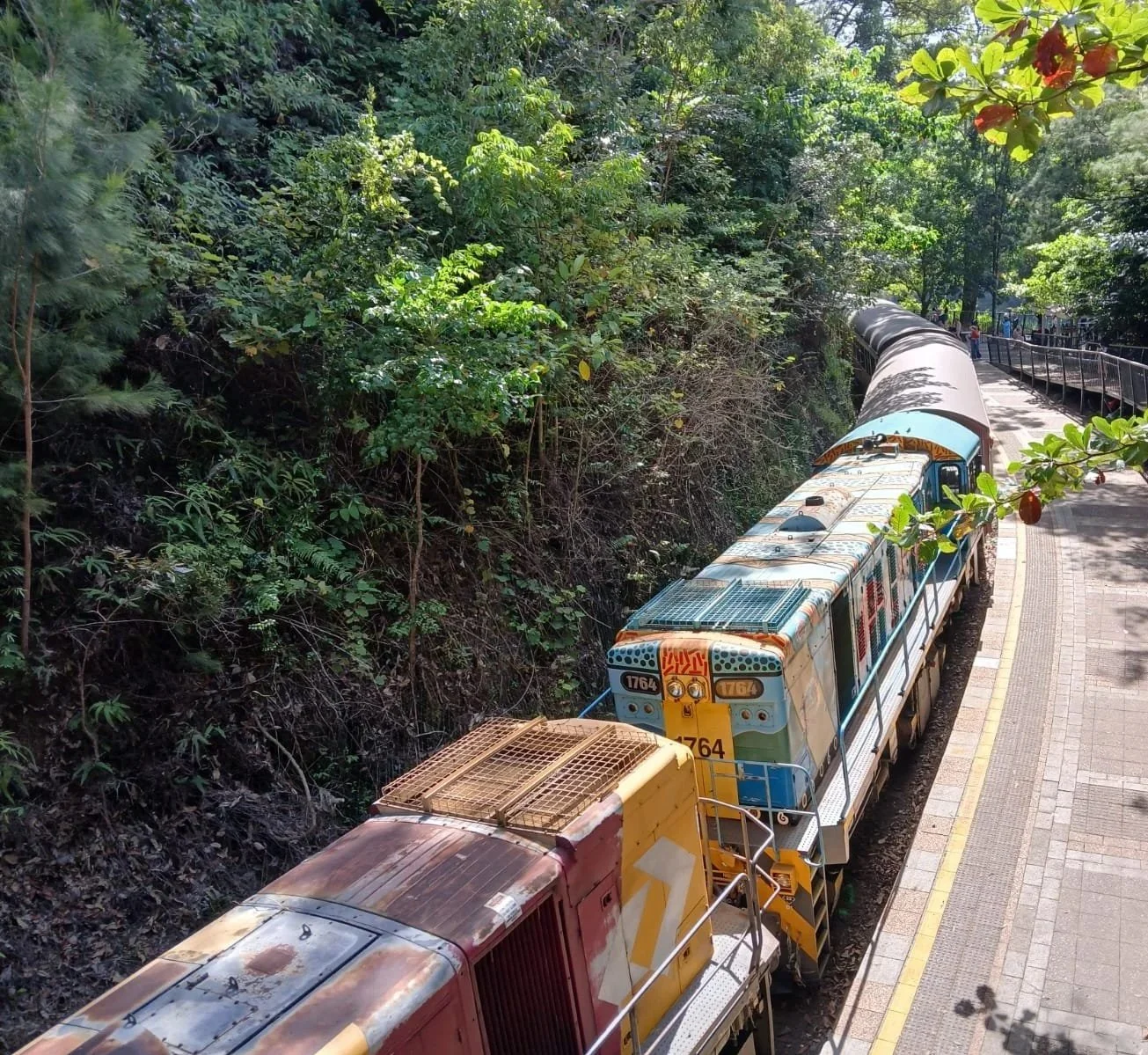
Dickie, Ted and I took a wonderful day trip into the hinterland on the Karunda Scenic Railway, following in the footsteps of the gold rush miners of yester year. Gerald stayed behind on Walrus and set to fixing things. He spent the day taking apart the cooker to fit the newly purchased part. When we returned at the end of the day, the cooker was working again. No more balancing act with the tongs every time I used the oven, I was hugely grateful.
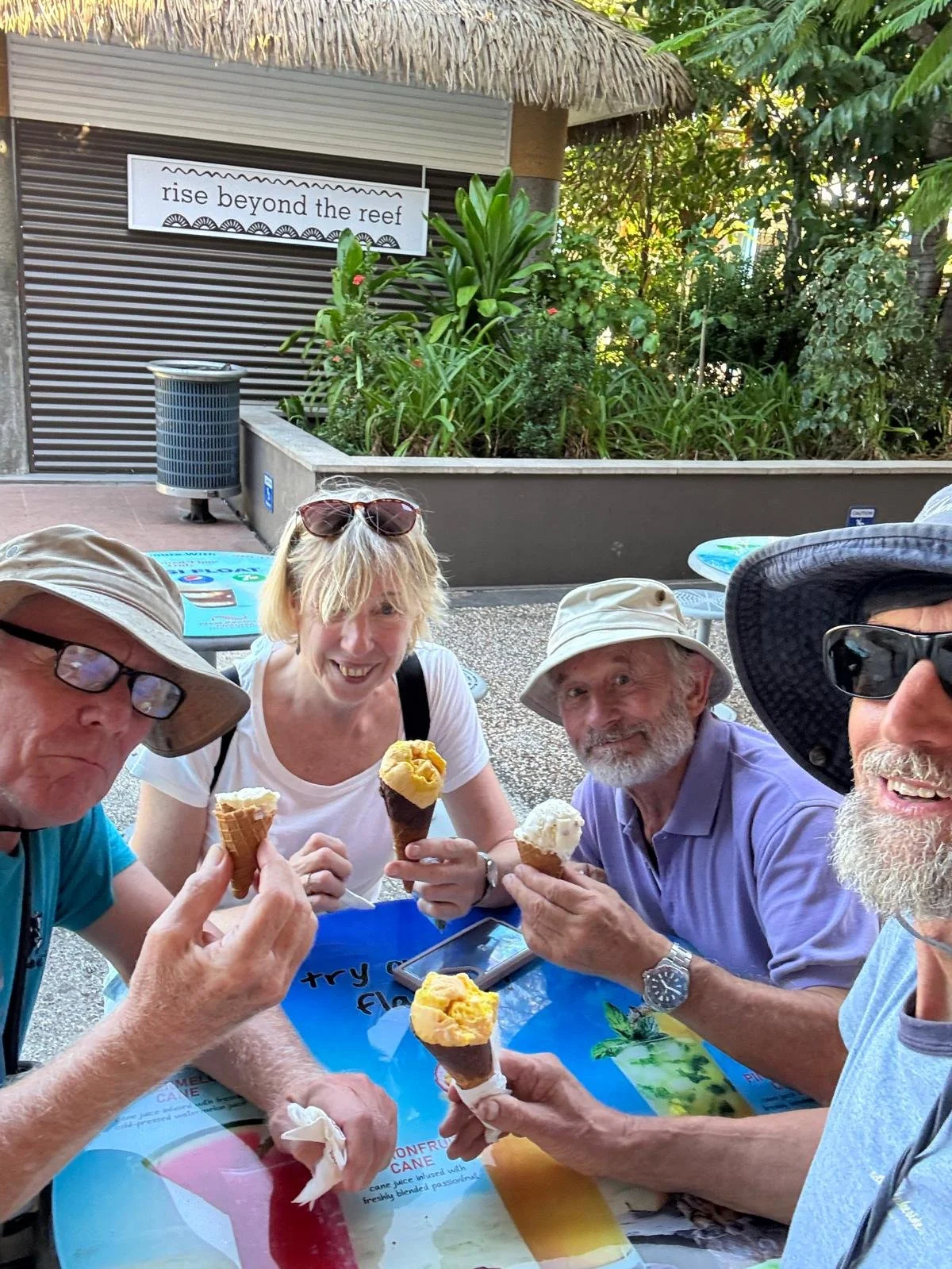
New joiners to the World ARC family, Matt, Kira and their children, Evelyn, then aged 7yrs and Riley, then aged 4 yrs were moored in their catamaran, Wonder, just down the pontoon from Walrus. I had spotted the children on board and wondered if they might join Ted and I (Dicky and Gerald having declined the opportunity) in an ice cream and turn on the giant ferris wheel behind the beach. This proved to be a popular choice, we had a great time. Since then I’ve been on the look out for ice cream and ferris wheels for a repeat evening’s entertainment. Maybe there’s an insta account in the making FWAW (Ferris Wheels Around the World)?
Northern Territories… Never smile at a crocodile
At the World ARC Briefing in Mackay we were warned that salt-water crocodiles were a danger along the coast of northern Australia. Between 2015-2024 eleven people had been killed by salt-water crocodiles in Australia. These crocs were reported to be canny creatures which watched and waited, before going for the kill. Yachties were warned that saltwater crocs watch for repeated behaviour patterns and use this information to plan when to strike. Any actions, such as regular early morning washing of boat parts in the sea, near an estuary, could result in a saltwater crocodile attack. As if to prove the point there were, ‘Watch out for Crocs’ signs along the beaches in Darwin, where despite the hot weather and beautiful sandy beaches, swimmers or paddlers were noticeably absent.
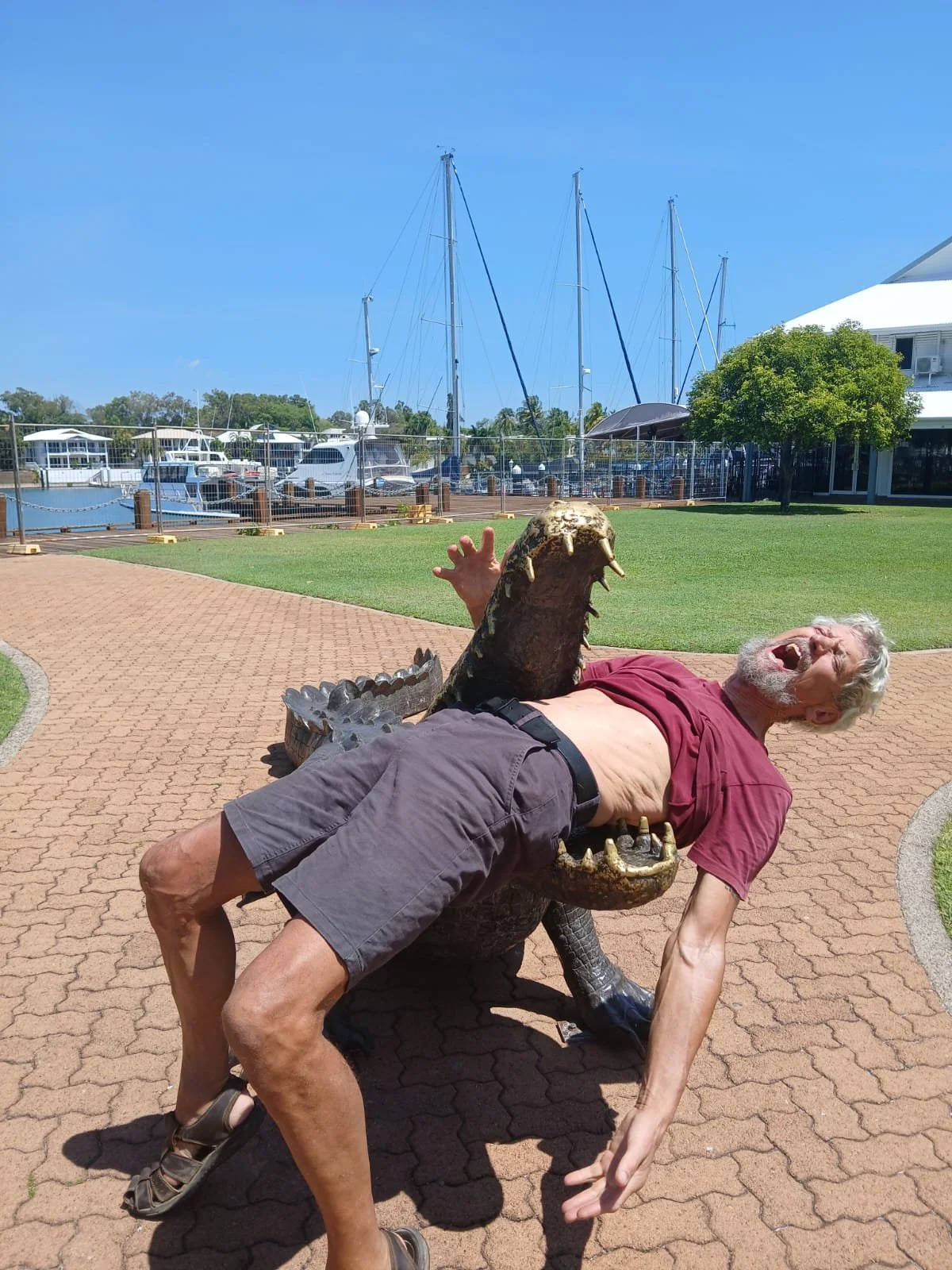
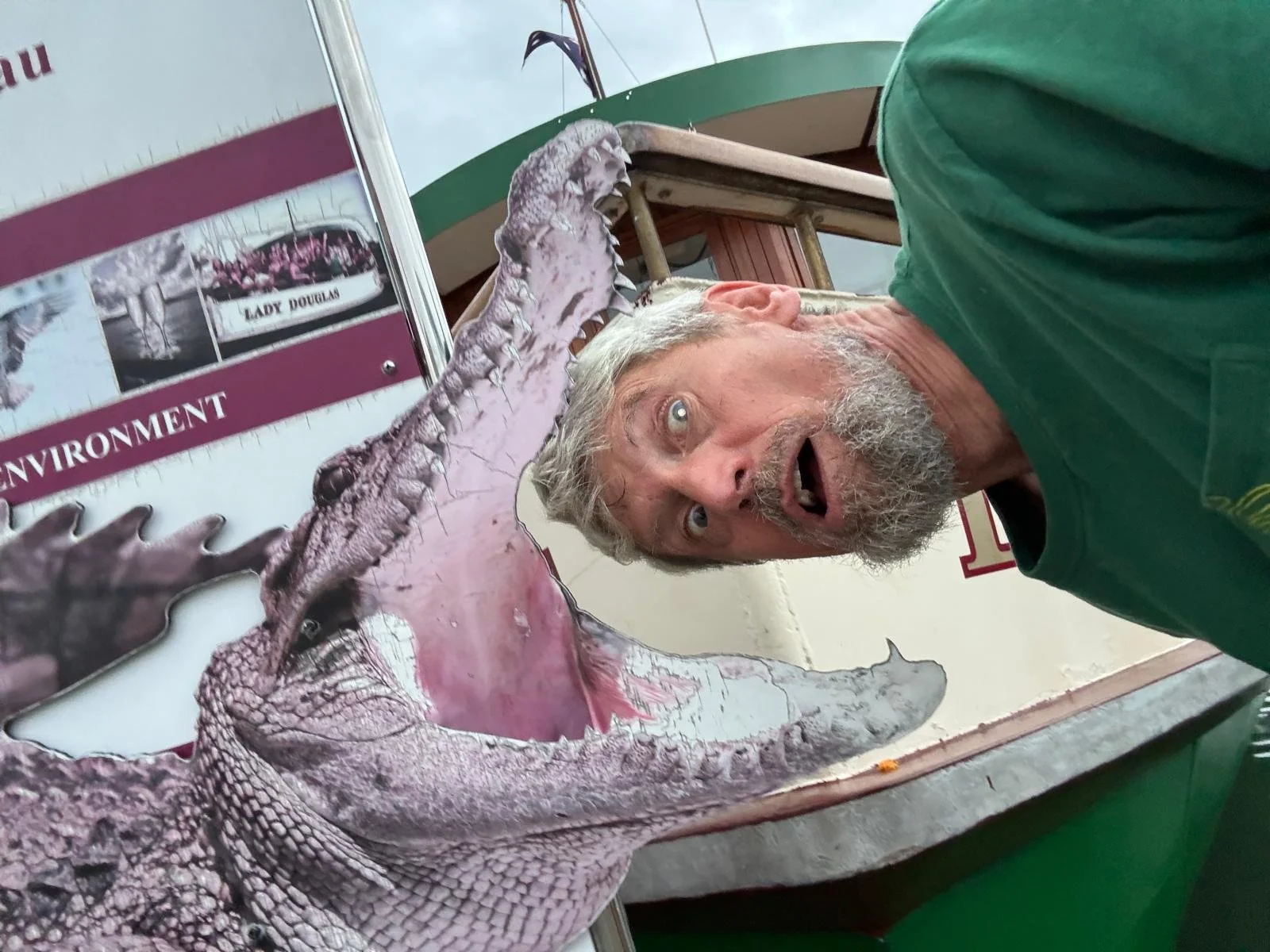
The World ARC organised an outing on a river cruise to see salt-water crocs in the wild. The tour guides swung raw chicken on the end of long bamboo poles to attract crocodiles of varying lengths from 2-3 metres to as long as 5 metres. As the crocs jumped and lunged at the bait their jaws snapped shut with a resounding, ominous cracking sound. The way the muscles of the crocs’ jaws work means once fixed around their prey there’s no letting go. I was glad to be safely protected behind steel netting around the outside of the not-very-big river cruiser.
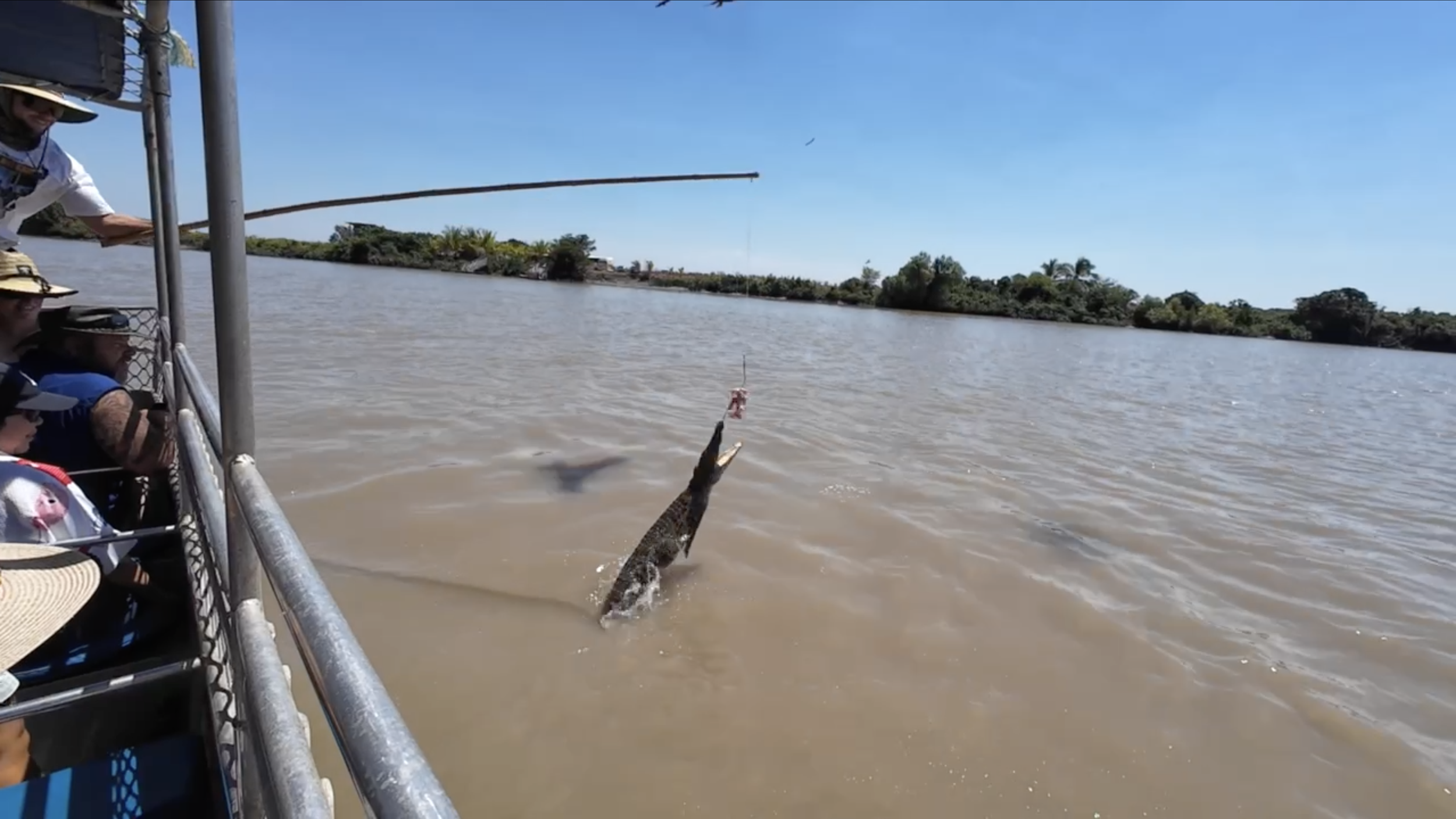
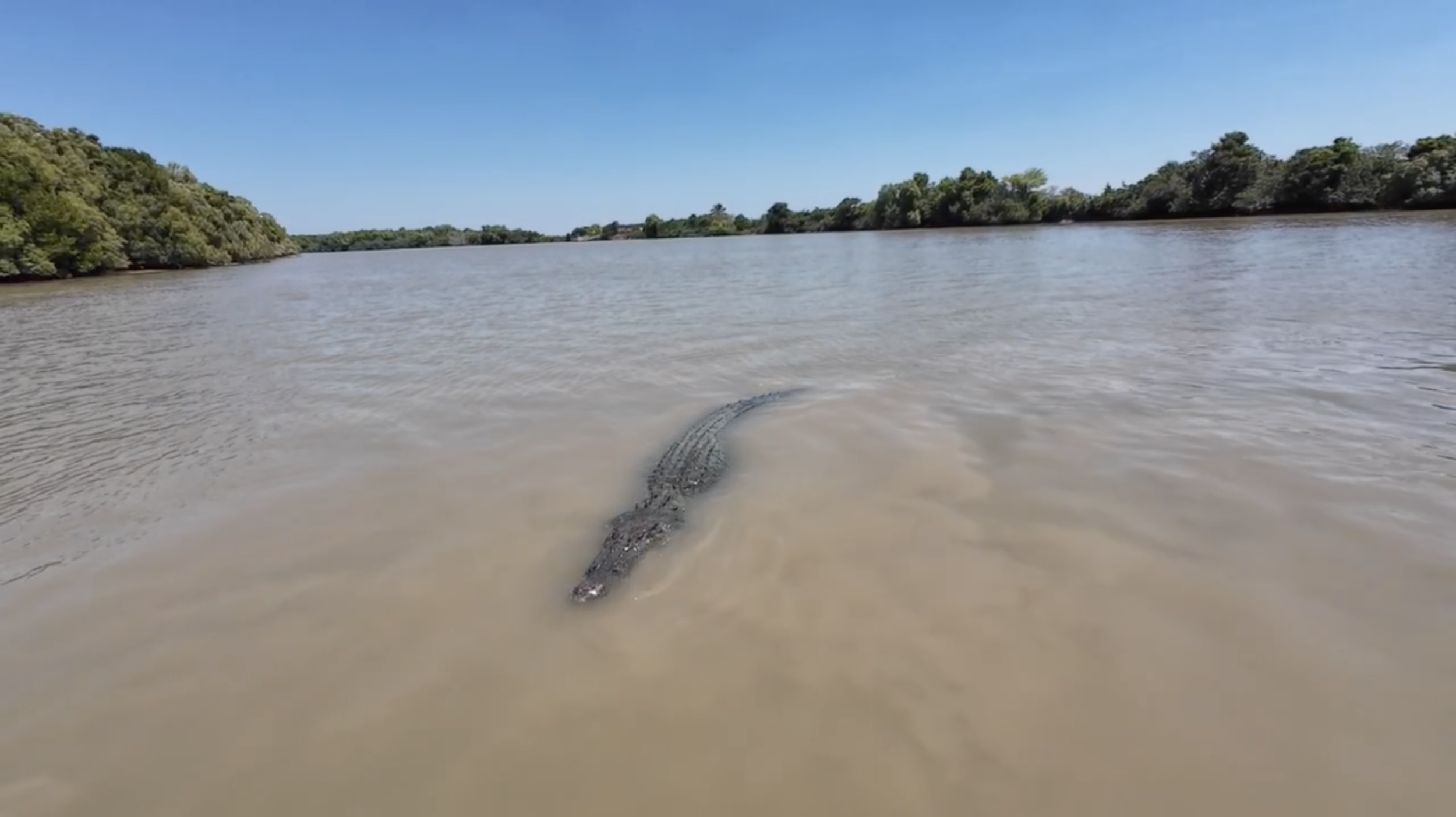
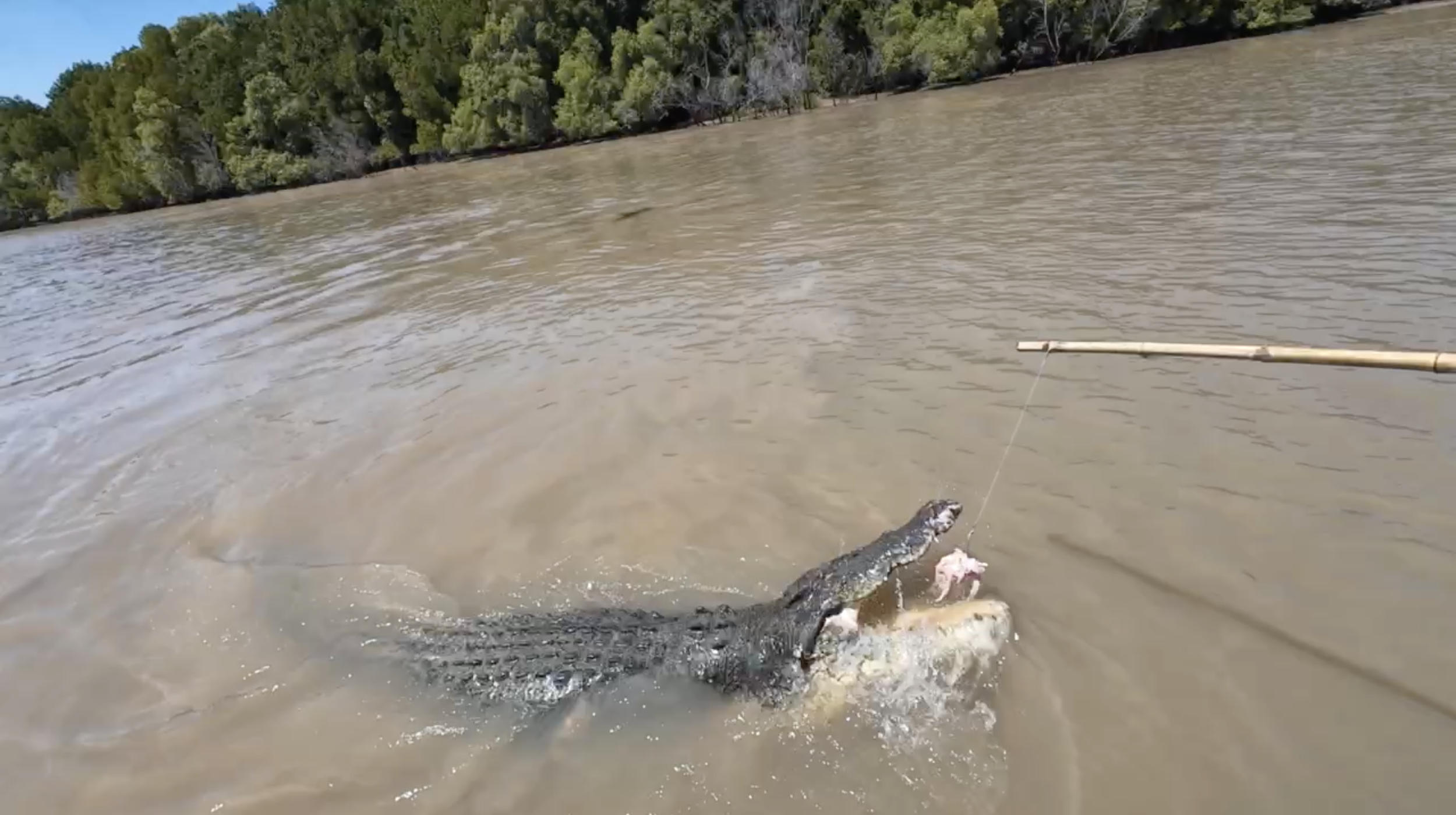
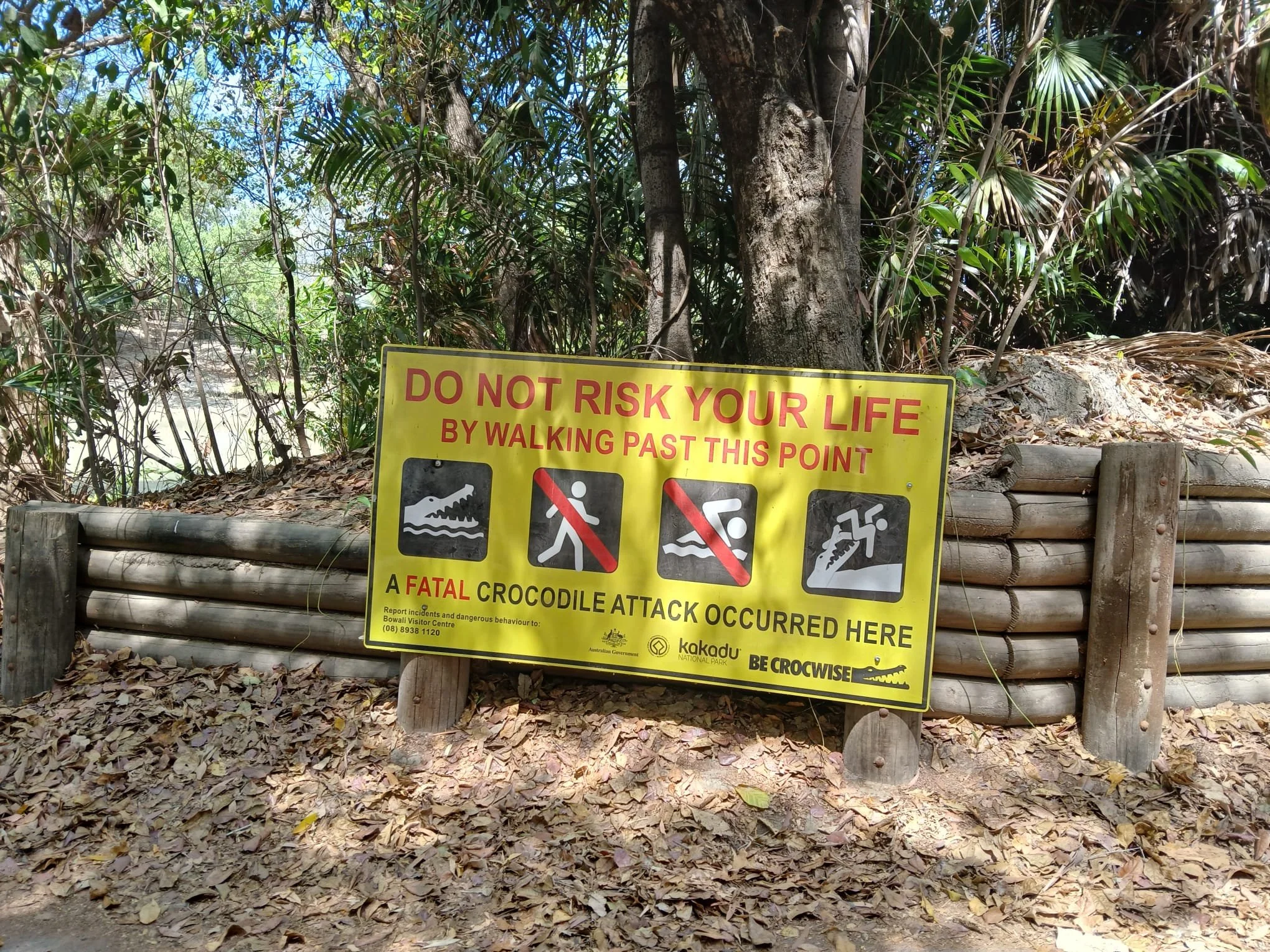
On the way to Cooinda National Park, Dickie, Ted and I stopped for a picnic unknowingly, until later, just 20 feet from a sign announcing that there had been a fatal crocodile attack at the site. Sure enough when we looked around, we spied a large saltwater crocodile on the opposite bank of the river. It took us just a few minutes to pack up our things and move on to pastures new and the delights of First Nations rock art, the comfort of Cooinda Lodge and the wild red rock beauty of the park.
Camel riding on Mindel Beach
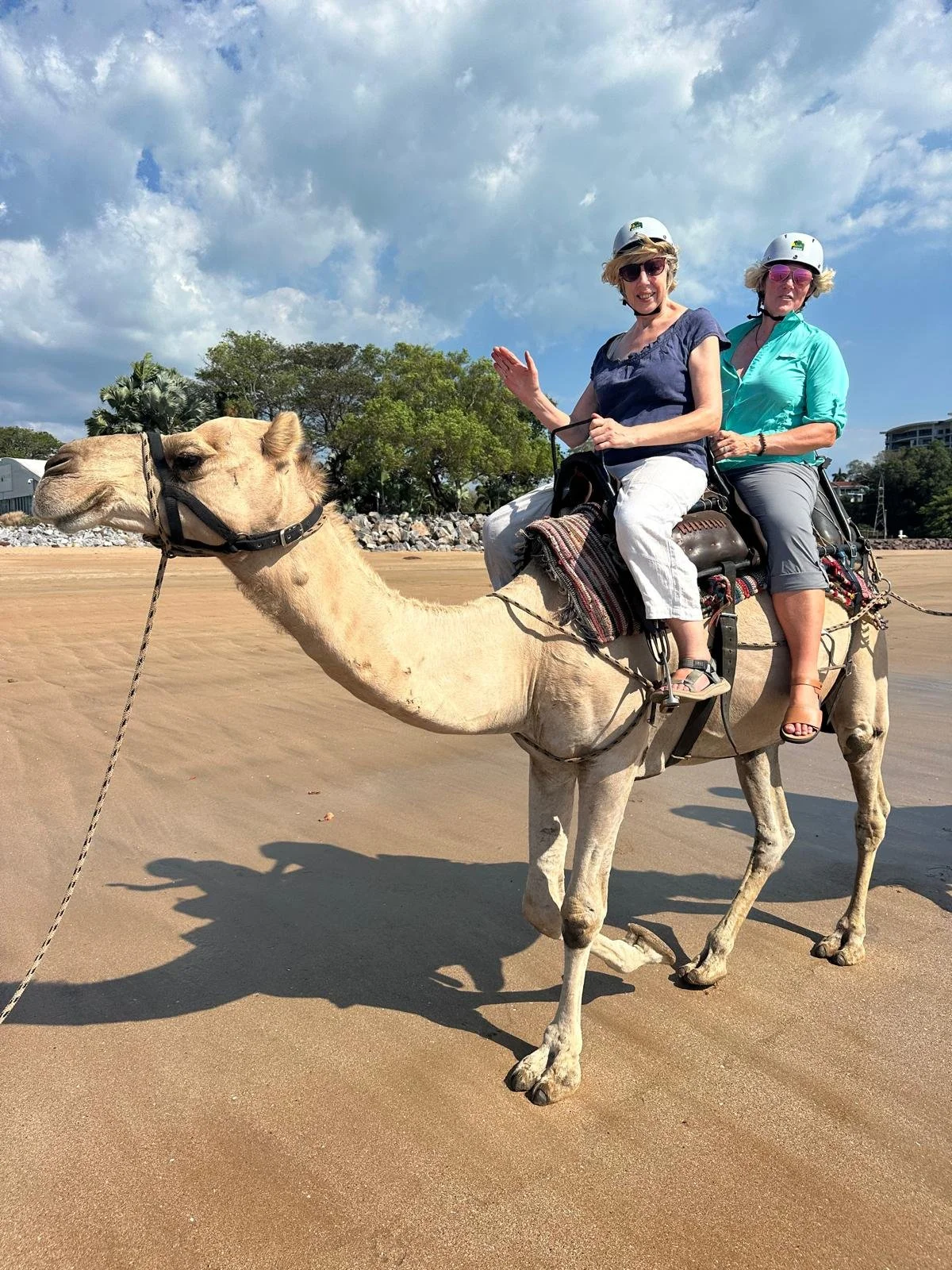
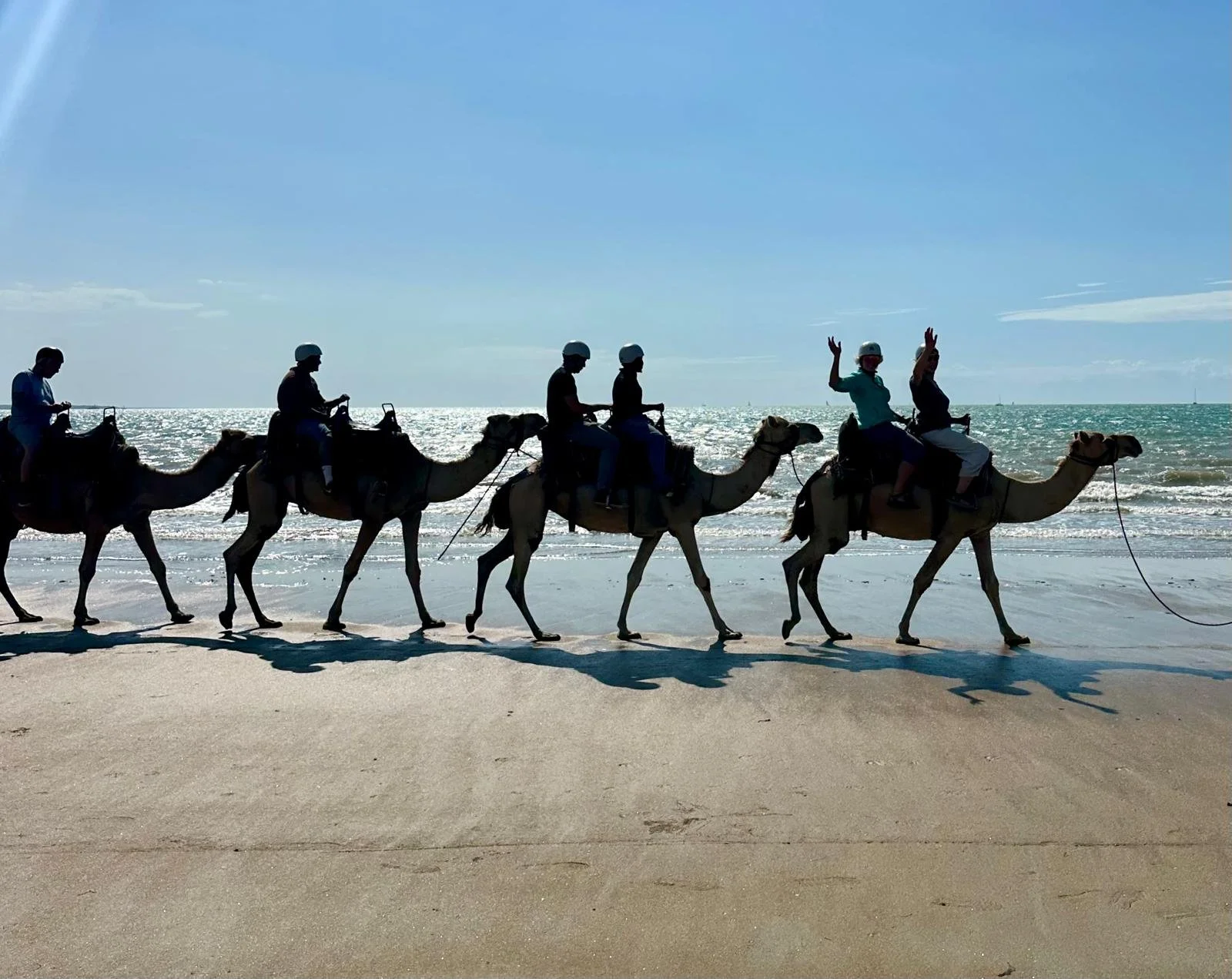
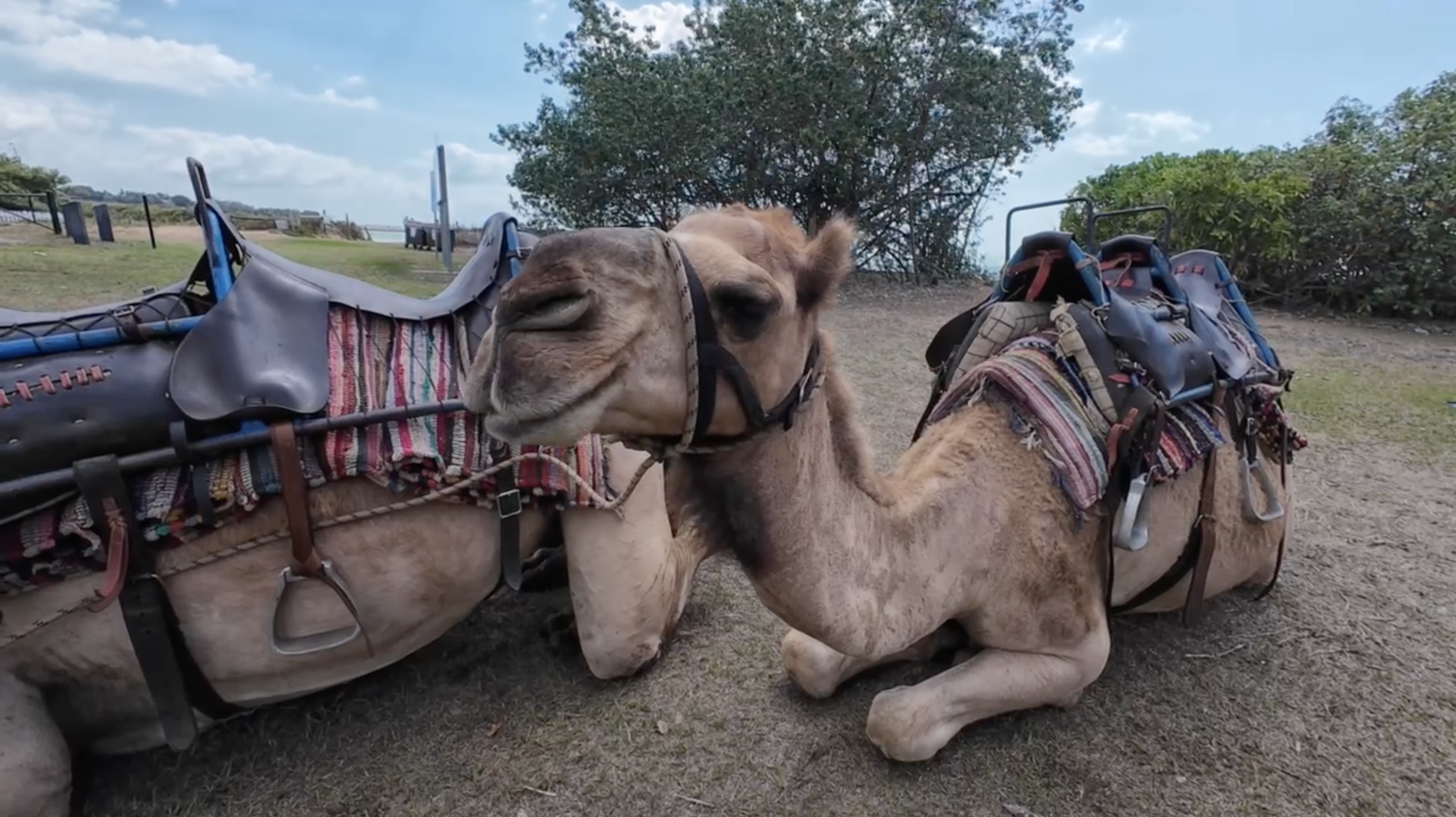
There are more than 700,000 feral camels in Australia and the chief cameleer on Mindel Beach, Darwin had tamed three of these camels and a fourth that had been rescued to give rides along the beach. Martha and I were given Brutus, the largest of the camels to ride. He looked down his nose disdainfully at us… we were informed he was not a camel to be petted. He was in work mode, he took his job as leader of the group of four seriously and did not want to be distracted from his duties. After mounting our given camels from the side of a large horse box we galumphed our way along the seashore just out of range of the saltwater crocodiles, moving gracefully (I like to think) in an elegant camel caravan. Dickie was the back marker on his camel, Mohammed. I was in heaven… the ride ended all too quickly 45 minutes later when we had circumnavigated the beach and Brutus had had his fill of staring at the beach volleyballers en route. Our reward, an enormous ice cream from Mindel Beach street market.
Interlude in Perth where winter is cold
I took a brief sojourn from Walrus to visit Dickie’s son, Philip’s parents in law, Barry and Trixie and my half sister, Carolyn in Perth.
A big, thank you, to Barry and Trixie for overnight stay in their gorgeous house overlooking the Swan River and for lunch at the Fremantle Yacht Club.
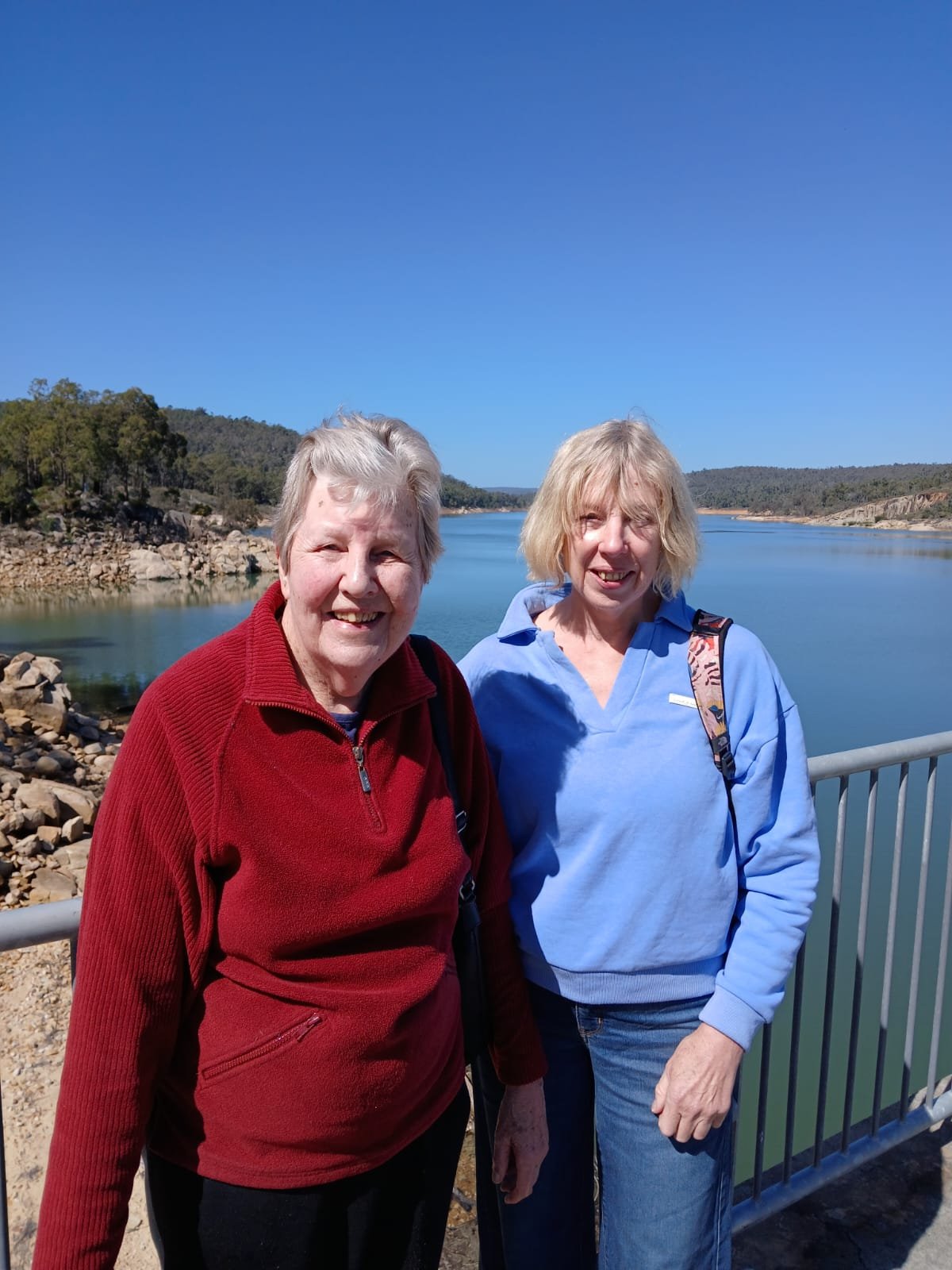
I spent a wonderful three days with Carolyn in the hills above Perth. It was true winter weather, bright and cold. I met her friends at the local bowls club, visited a beautiful reservoir surrounded by wild bush countryside.
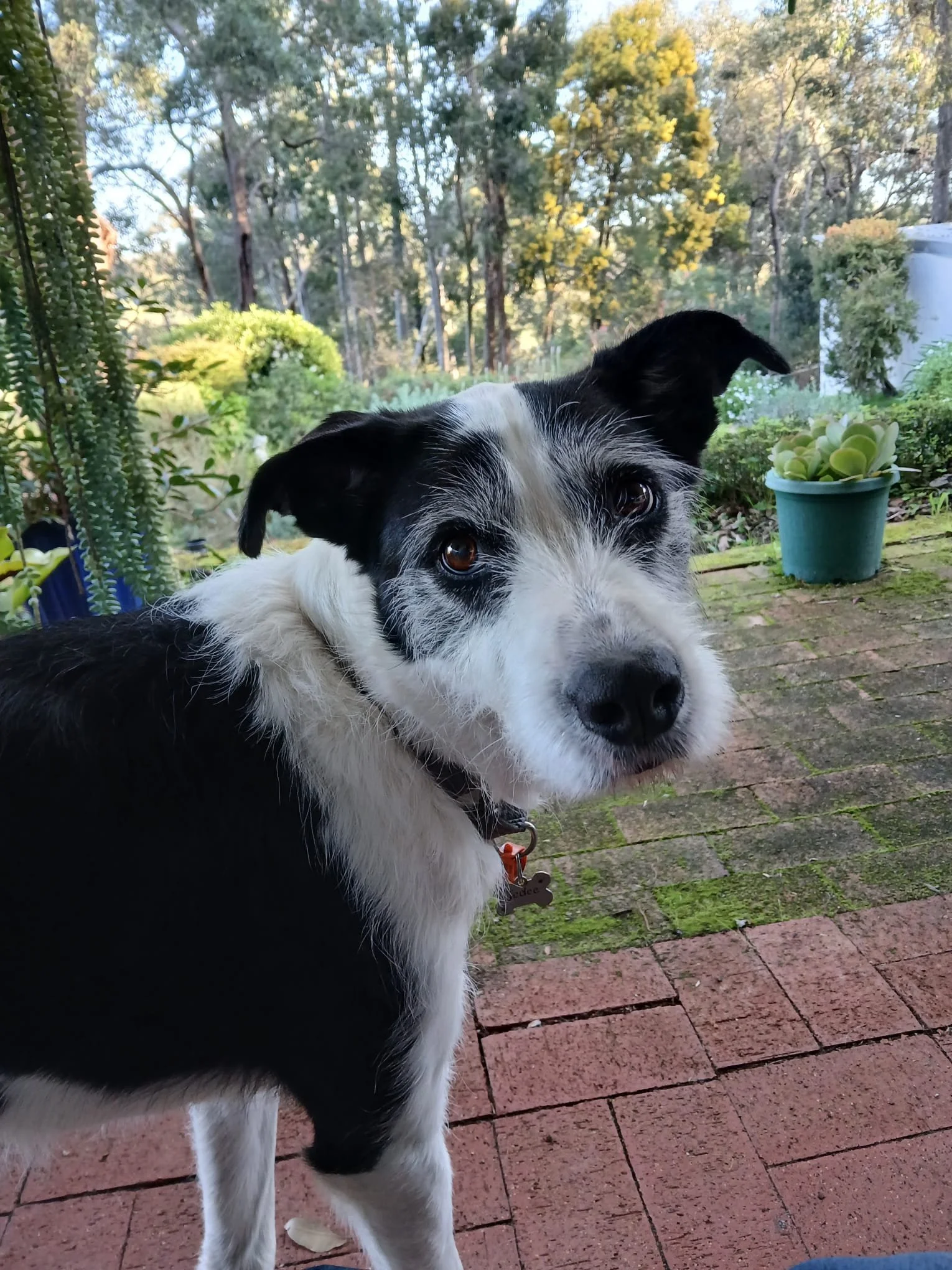
Best of all I met, Jedee, Carolyn’s Irish wolfhound cross border collie.. and saw five wild kangaroo leap across the wide playing field where he goes every morning for his daily exercise. I rejoined Walrus ready for the journey ahead across the Indian and Atlantic Oceans.
Goodbye and Good Luck to Gerald
In Darwin Gerald left Walrus to rejoin his wife, Maura in Ireland and to see his five daughters, their partners and his grandchildren. Gerald has been an amazing crew member, his problem-solving skills beyond compare.
Gerald’s sailing capabilities are remarkable, his creative use of sails and lines to get the most out of Walrus, a revelation. We’ve missed him. During his time aboard Walrus Gerald gained a fan club and a line of people with things to fix.
Extra note - Dickie and Gerald shared a passion for Irish whisky…. supplies rapidly depleted between Gibraltar (November 2024) and Darwin (August 2025).
You’ll be glad to hear Gerald will be joining Walrus again for the final parade of sail in St Lucia, in April 2026. We await his return with eager anticipation - there’s a bottle of Bushmills in his locker to welcome him back.
Walrus Update January 2026 - Spoiler alert: One, two, miss a few
Walrus is currently sailing across the South Atlantic from Walvis Bay, Namibia to St Helena.
Blogs will restart with the passage from La Reunion to South Africa. Vlogs have been interrupted by Roland’s new job and the arrival of baby Marlowe.
Fingers crossed one or two vlogs will be underway in the not too distant future. Dickie, Alison and Ted wish Walrus Around the World’s followers a belated very happy 2026.